

MCAS can be confusing because symptoms may appear in several body systems and can overlap with allergies, gastrointestinal disorders, cardiovascular problems, and other conditions. A careful diagnosis matters: symptoms alone do not establish MCAS.
What Is Mast Cell Activation Syndrome?
Mast cells are immune cells found throughout the body, especially in the skin, airways, gastrointestinal tract, and tissues surrounding blood vessels and nerves. When activated appropriately, they release chemical mediators – including histamine, tryptase, prostaglandins, and leukotrienes – that help the body respond to threats.
In Mast Cell Activation Syndrome (MCAS), patients experience recurrent episodes consistent with systemic mast-cell mediator release. Current consensus criteria emphasize three elements: typical symptoms affecting at least two organ systems, objective evidence that mast-cell mediators increased during an episode, and improvement with therapies directed at mast-cell mediators or activation. [1]
What Symptoms Can MCAS Cause?
The pattern matters more than any single symptom. Typical episodes may include flushing, hives, itching or swelling; abdominal cramping, diarrhea, nausea or vomiting; wheezing or shortness of breath; and cardiovascular symptoms such as a rapid heart rate, low blood pressure, fainting or near-fainting. [1]

Patients may also report symptoms such as headache or difficulty concentrating, but these symptoms are nonspecific. They should not be used alone to diagnose MCAS. In fact, experts caution that broad symptom lists can lead to overdiagnosis and can delay identification of another treatable condition. [2]
Why Can MCAS Be Difficult to Diagnose?
MCAS is not diagnosed simply because a patient has many unexplained symptoms or feels better after taking an antihistamine. The clinical pattern, laboratory evidence, timing of testing, and response to treatment all matter. Other conditions that can mimic the symptoms also need to be considered.
Testing is especially time-sensitive. The American Academy of Allergy, Asthma & Immunology (AAAAI) notes that serum tryptase is most useful when drawn during an acute episode and compared with a baseline level obtained later. Selected urinary mast-cell mediators may also be used. [3]

What Causes MCAS – and What Can Trigger Symptoms?
MCAS is not something a person “catches.” Mast-cell activation disorders can be primary/clonal, secondary to another process such as an allergic reaction, or idiopathic when no underlying driver is identified. Patients may notice that episodes occur around certain foods, medications, temperature changes, exercise, alcohol, stress, hormonal changes, or other exposures, but a trigger is not necessarily the underlying cause. [1]
This distinction is important in an integrative evaluation. A detailed history can help identify patterns worth investigating without assuming that every exposure or symptom is proof of MCAS.
MCAS and Histamine Intolerance: Related Ideas, Different Questions
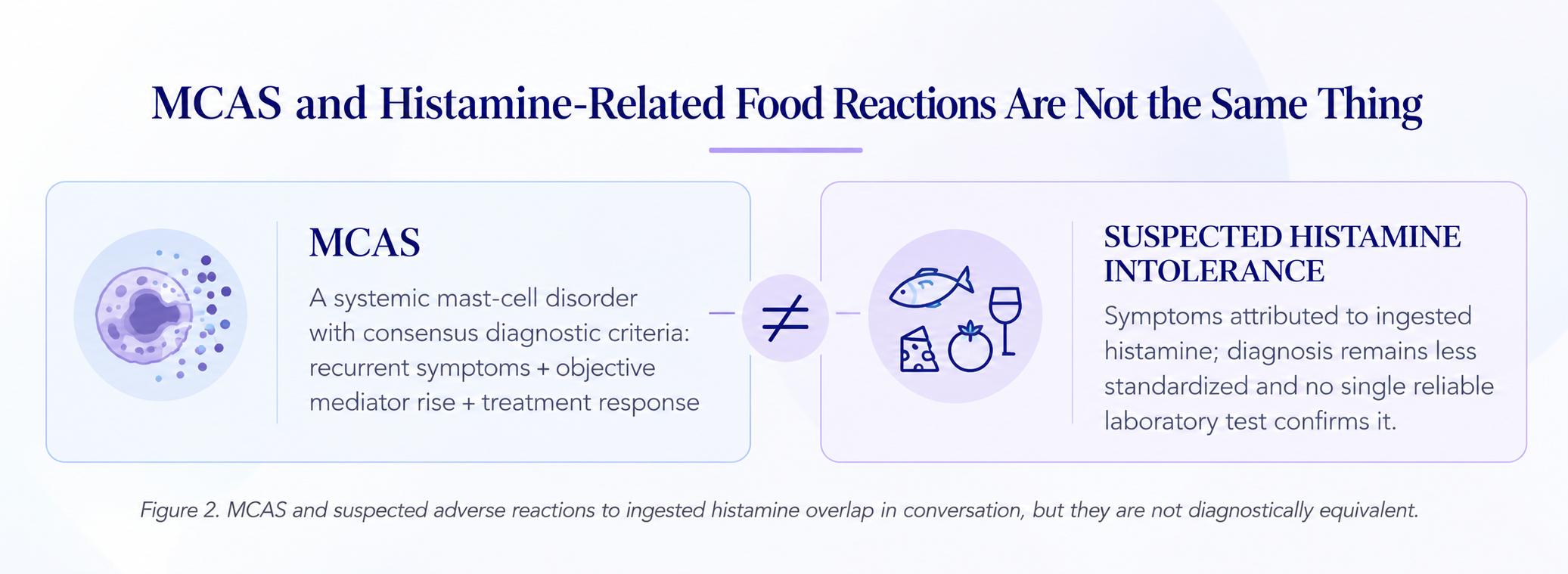
The terms MCAS and “histamine intolerance” are often used together online, but they should not be treated as interchangeable diagnoses. MCAS has consensus diagnostic criteria focused on systemic mast-cell activation. Histamine intolerance generally refers to symptoms attributed to histamine from foods, sometimes proposed to involve impaired histamine breakdown.
The evidence for histamine intolerance is less settled. Reviews and allergy guidelines note that there is no single validated laboratory test that reliably confirms the diagnosis, and serum diamine oxidase (DAO) testing has important limitations. Broad, long-term low-histamine diets can also become unnecessarily restrictive. A symptom-and-food history, consideration of other diagnoses, and carefully supervised dietary changes may be more useful than assuming that a low DAO result explains the entire picture. [4, 5]
How Is MCAS Treated?
Treatment is individualized and depends on the patient’s presentation and the type of mast-cell disorder. Clinicians may use H1 or H2 antihistamines, leukotriene-modifying medications, mast-cell stabilizing approaches, or other therapies when appropriate. Severe acute reactions should be treated as anaphylaxis; epinephrine is first-line treatment when indicated. [3]
The goal is not simply to suppress every symptom. It is to reduce episodes, identify relevant triggers when possible, treat associated conditions appropriately, and reassess whether the working diagnosis still fits the evidence.
Where Does a Functional, Integrative Approach Fit?
For patients with complex or long-standing symptoms, integrative care can help organize the broader health story while complementing appropriate allergy/immunology and conventional medical evaluation. At Monarch Integrative Health, this may include reviewing the complete symptom timeline, previous diagnoses and treatments, medications and supplements, nutrition, sleep, gastrointestinal health, environmental exposures, stress, hormonal factors, and other medical conditions that may influence how a patient feels.
The purpose is not to label every multisystem illness as MCAS. It is to connect relevant clues, determine which possibilities deserve investigation, avoid unnecessary restriction or testing, and build an individualized plan that can be measured and adjusted over time.
LISTEN → CONNECT THE CLUES → PRIORITIZE → TREAT → MEASURE → ADJUST
When Should You Seek Urgent Care?
Symptoms such as trouble breathing, throat swelling, fainting, severe low blood pressure, or a rapidly progressing systemic allergic reaction can be medical emergencies. Seek emergency care for suspected anaphylaxis and use prescribed epinephrine according to your emergency plan.
The Takeaway
MCAS is real, but it is also easy to misunderstand because many of its symptoms occur in other conditions. A strong evaluation looks for patterns across body systems, uses objective testing appropriately, considers other explanations, and measures response to treatment. Histamine-related food symptoms deserve the same thoughtful approach – without automatically assuming MCAS or committing a patient to a highly restrictive diet.
If you’re experiencing recurring symptoms across multiple body systems and haven’t found a clear explanation, a comprehensive evaluation can help organize the clues and determine what deserves further investigation.
References & Footnotes

Franca Gardner
ANP-BC, DiHom