

When symptoms are chronic, complicated, or involve several body systems, choosing a provider can feel overwhelming. The words “integrative” and “functional” describe an approach to care—but they do not, by themselves, tell you how much medical training, clinical experience, or complex-case judgment a provider has.
Why Choosing the Right Provider Matters
For straightforward health concerns, the path to care may be relatively clear. Complex chronic symptoms are different. A patient may have fatigue, headaches, digestive changes, sleep problems, pain, dizziness, cognitive symptoms, or other concerns that cross several body systems. They may also arrive with years of medical records, prior diagnoses, medications, supplements, and testing.
In these situations, the challenge is not simply collecting more information. It is deciding which information matters, what has already been adequately evaluated, which questions should come next, and when another specialist or conventional medical evaluation is needed. That is why credentials matter – but so do listening, communication, pattern recognition, clinical judgment, and experience.[1]
Start With the Basics: Education, Licensure & Scope
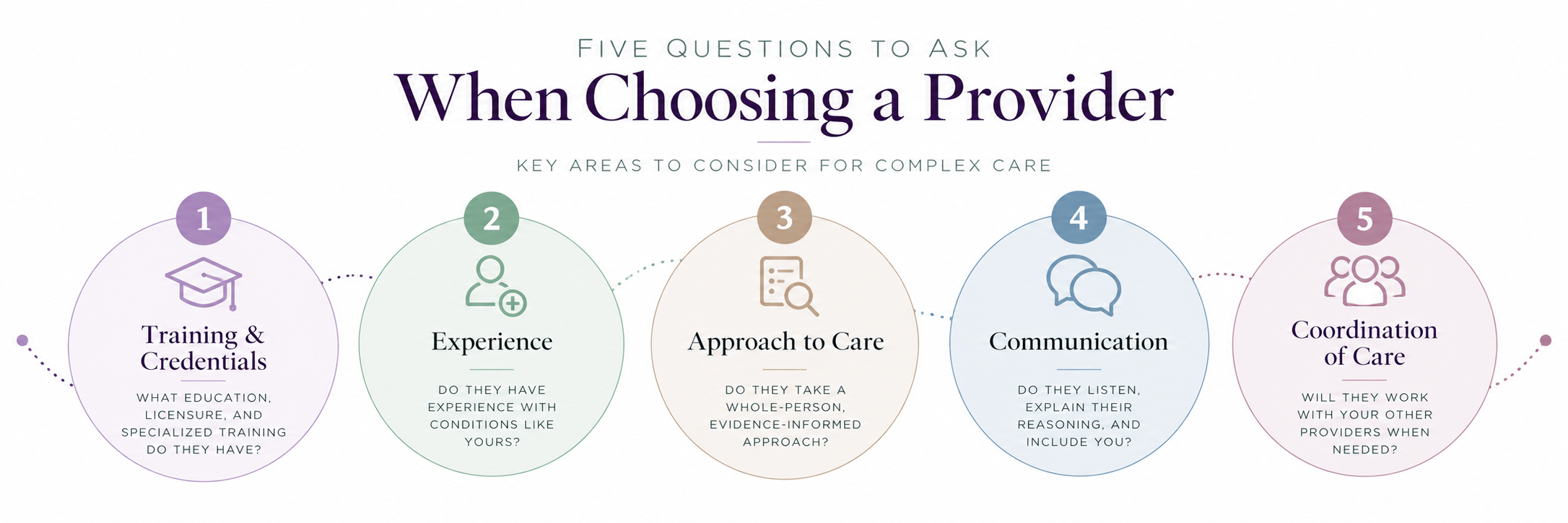
NCCIH recommends researching a complementary or integrative health practitioner as carefully as you would a conventional healthcare provider. Patients should ask about education, training, licensing, certifications, and experience. Requirements can vary substantially by profession and by state.[1][2]
Start by asking what formal medical or health-professional education the provider completed and what additional integrative or functional training is relevant to your needs. Confirm that the provider is appropriately licensed for the services being offered and that recommendations fall within that professional scope.[5] Also ask how the provider stays current with evidence, safety information, clinical guidelines, and changes in practice.
A title or philosophy should never replace these basic questions. “Integrative” and “functional” are not, by themselves, credentials.
Integrative vs. Functional Medicine: What Do the Terms Mean?
These terms overlap and practices may use them differently. NCCIH generally uses “integrative health” to describe coordinated use of conventional and complementary approaches, often with attention to the whole person.[3]
“Functional medicine” is commonly used for an individualized, systems-oriented style of care that explores relationships among a person’s history, lifestyle, environment, physiology, and symptoms. Because the term is used in different ways, patients should look beyond the label and evaluate the provider’s actual professional training, licensure, clinical role, and treatment approach.
For patients, the more useful question may be: Does this provider combine a whole-person perspective with appropriate medical evaluation, evidence, safety, and coordination of care?
What Should You Look For With Complex Symptoms?
Good care often becomes visible in the process. A thoughtful provider takes time to understand the full history, explains the reasoning behind testing and treatment, looks for meaningful patterns without forcing every symptom into one theory, and works within their expertise. When another clinician or specialist is needed, coordinated care is a strength – not a failure.[1]
The plan should also be understandable. Patients should know why a test, supplement, medication, dietary change, or other intervention is being considered; what benefits and limitations are expected; what it may cost; what risks or interactions deserve attention; and how progress will be measured. NCCIH specifically encourages patients to tell all of their healthcare providers about complementary approaches and products they use so care can be coordinated safely.[3][4]
Why Experience and Clinical Judgment Matter
Experience becomes especially valuable when the first explanation does not account for the whole picture. An experienced clinician may recognize that two symptoms that seem unrelated deserve to be considered together – or that an appealing theory does not fit the evidence and another explanation needs investigation.
This does not mean experience guarantees the correct diagnosis or outcome. No provider can promise that. Rather, experience can strengthen the ability to ask better questions, recognize patterns, avoid unnecessary repetition, understand when a finding is meaningful, and know when to change direction.
Red Flags Worth Paying Attention To
Be cautious when a provider promises a cure, guarantees a rapid result, claims one test explains nearly every chronic condition, discourages necessary conventional care, or recommends a long list of products without explaining why each one is needed. A responsible provider should be comfortable discussing uncertainty and should not treat questions as resistance.
“Natural” also does not automatically mean safe. Herbs and dietary supplements can have side effects, quality concerns, or interactions with medications. NCCIH recommends considering the evidence and safety of each complementary product or practice individually.[3][4]
The Monarch Integrative Health Approach
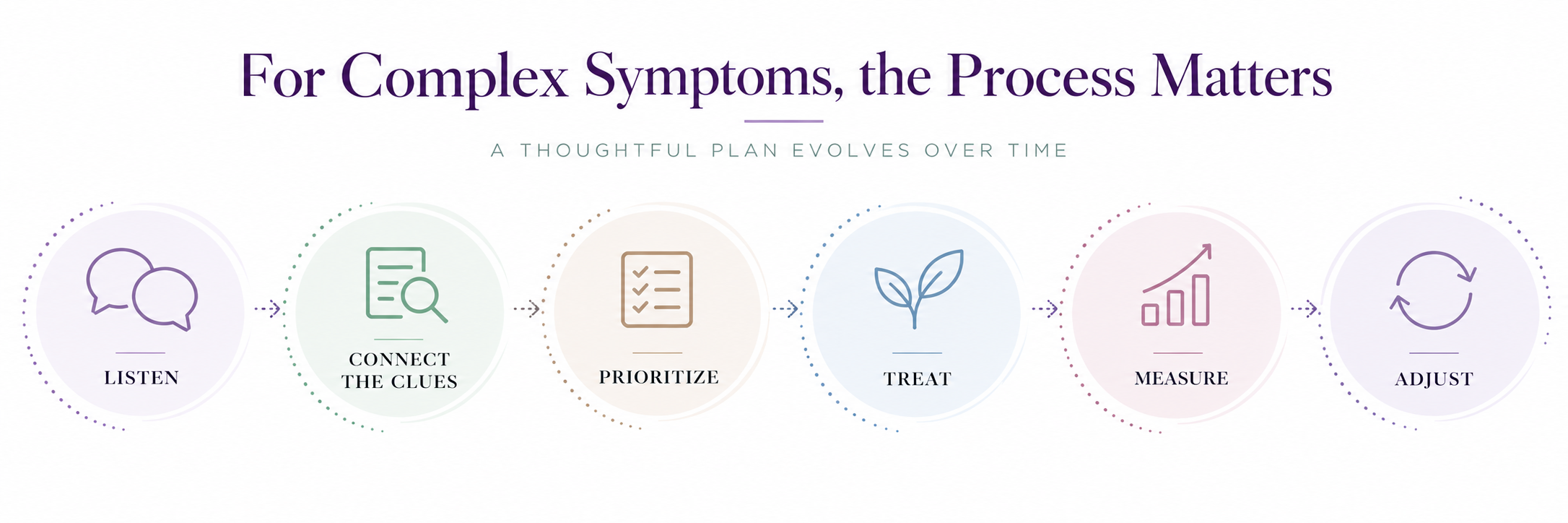
At Monarch Integrative Health, the goal is to understand the whole health story rather than focus only on one symptom or one body system. That means listening carefully, reviewing what has already happened, connecting relevant clues, prioritizing what deserves attention, and building a plan that can be adjusted as new information emerges.
Franca Gardner, ANP-BC, DiHom, brings more than 30 years of healthcare experience to this process, with particular focus on patients whose symptoms are chronic, complex, or difficult to connect. Many patients come to Monarch after years of evaluations, multiple providers, extensive testing, or treatment plans that have addressed individual symptoms without fully explaining the larger picture.
For patients with complex chronic symptoms, this can be particularly important. The first visit may not produce a complete answer – and responsible care should not pretend that it always will. A long health history can contain multiple layers. Progress may require addressing the highest-priority issues first, observing the response, and then deciding what comes next.
The aim is purposeful investigation rather than endless testing: LISTEN → CONNECT THE CLUES → PRIORITIZE → TREAT → MEASURE → ADJUST.
Questions to Bring to Your First Visit
A good provider should welcome thoughtful questions. Ask about professional education and licensure, experience with concerns similar to yours, the reasoning behind proposed testing, how medications and supplements are reviewed for interactions, expected costs, how progress will be measured, and how the provider coordinates with your primary care clinician or specialists when appropriate.
Also pay attention to how the conversation feels. Do you feel heard? Are complicated ideas explained in a way you can understand? Are uncertainties acknowledged? Is there a clear reason for the next step? A strong therapeutic relationship is not about agreeing with everything; it is about being able to make informed decisions together.
The Bottom Line
Choosing an integrative or functional medicine provider should involve more than finding the right label on a website. Look for appropriate education and licensure, relevant clinical experience, evidence-informed decision-making, careful listening, transparent reasoning, and willingness to coordinate care.
For complex illness, the value of a provider is often not the number of therapies offered. It is the ability to understand a complicated story, identify what deserves attention, explain the plan, measure what happens next, and adjust thoughtfully along the way.
For someone who has been ill for years, the better question may not be, “Who offers the most treatments?” but “Who will take the time to understand my history, explain the reasoning, and help me work through the problem step by step?”
References & Footnotes
[2] NCCIH. Credentialing, Licensing, and Education. Accessed August 2026.
[3] NCCIH. Are You Considering a Complementary Health Approach? Accessed August 2026.
[4] NCCIH. Safe Use of Complementary Health Products and Practices. Accessed August 2026.

Franca Gardner
ANP-BC, DiHom