
Colorado is known for its dry climate, so indoor mold may be the last thing many people expect. But mold does not require a humid climate—it requires moisture. A small leak, condensation problem, damp bathroom, basement moisture, or past water damage can create a localized place for mold to grow, sometimes completely out of sight.
What Is Mold Exposure?
Mold is a type of fungus that is naturally present indoors and outdoors. Tiny spores can enter buildings through doors, windows, vents, heating and air-conditioning systems, or on clothing, shoes, bags, and pets. The presence of spores alone does not necessarily mean there is an indoor mold problem.
The problem begins when spores find persistent moisture. Mold can then grow on materials such as drywall, wood, insulation, carpet, ceiling tiles, and wallpaper. EPA guidance emphasizes a simple principle: the key to mold control is moisture control. Water-damaged materials should generally be dried within 24–48 hours to help prevent mold growth.[1]
Why Can Mold Be Hard to Find?
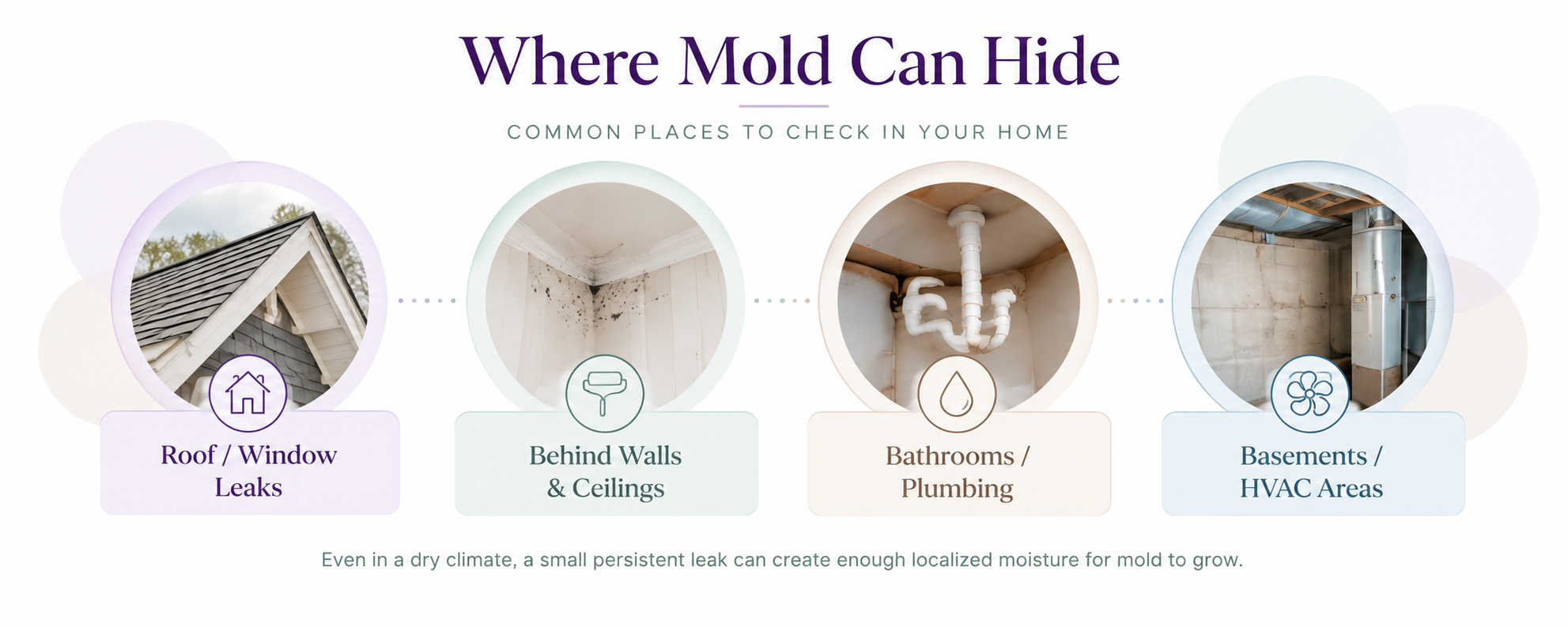
Indoor mold is not always visible. It may grow behind drywall or wallpaper, under flooring, above ceiling tiles, around leaking or condensing pipes, near poorly sealed windows, below roof leaks, or in damp bathrooms, basements, crawl spaces, and HVAC components when moisture is present.
That is one reason mold can be overlooked in Colorado. The outdoor air may feel dry while a hidden plumbing leak or condensation problem creates a very different microenvironment inside a wall. EPA notes that leaks, basement seepage, showers, cooking, and condensation on cold surfaces can all contribute to indoor moisture.[2]
A musty odor, repeated staining, bubbling paint, warped material, recurring condensation, or a history of water intrusion may be clues that deserve investigation.
What Symptoms Are Most Commonly Associated With Mold?
People respond differently to damp or moldy environments. Some have no symptoms. Others—particularly people with allergies, asthma, or mold sensitivity—may experience stuffy or runny nose, sneezing, irritated throat, coughing, wheezing, red or watery eyes, skin irritation, or worsening allergy or asthma symptoms.[1]
People also sometimes seek care for persistent headaches, fatigue, difficulty concentrating, dizziness, or simply feeling unwell. These symptoms deserve attention, but they have many possible causes. They should not be considered proof that mold is responsible. A careful medical evaluation is important, especially when symptoms involve several body systems or have continued for a long time.
What About “Black Mold”?
Stachybotrys chartarum is a greenish-black mold often referred to as “black mold.” It can grow on chronically water-damaged materials such as drywall, fiberboard, and paper. However, color alone does not determine whether a mold is more or less hazardous. Many molds can appear dark, and molds of other colors can also trigger allergic or respiratory problems.
The practical rule is more useful than focusing on color: significant indoor mold growth means there is a moisture problem that should be corrected. Removing visible mold without fixing the leak, condensation, or water source often means the problem will return.[1]
Before Disturbing Hidden or Extensive Mold
Finding mold does not always mean you should immediately tear out drywall or scrub a large contaminated area. Disturbing moldy materials can release spores and particles into the air and increase exposure.
EPA guidance says many small areas—generally less than about 10 square feet—can often be handled by homeowners following appropriate precautions. Larger areas, substantial water damage, contaminated water, suspected HVAC involvement, or hidden mold may justify an experienced remediation professional. People with health concerns should consider speaking with a healthcare professional before participating in cleanup.[1,3]
The objective is not simply to “kill” mold. The moisture source must be corrected and contaminated material appropriately cleaned or removed. EPA also notes that dead mold can still cause allergic reactions in some people.[1]
Why Can Mold-Related Health Concerns Become Complicated?
When the moisture problem is obvious and symptoms are primarily allergic or respiratory, the path may be relatively straightforward. The situation becomes more complicated when mold is hidden, symptoms are nonspecific, several medical conditions may overlap, or the patient has already been ill for months or years.
In those situations, there are often two separate questions: What is contributing to the patient’s symptoms? And where is the moisture or mold problem in the building? A medical evaluation cannot replace a qualified building investigation, and an environmental inspection cannot diagnose a medical condition. The two pieces may need to be considered together.

A Functional & Integrative Approach
A functional and integrative evaluation begins with the complete story rather than assuming a single explanation. That may include when symptoms began, where the patient spends time, whether symptoms change when away from a particular building, known water damage, respiratory and allergy history, medications and supplements, nutrition, sleep, gastrointestinal symptoms, stress, and other health conditions.
Testing, when appropriate, should be selected to answer specific clinical questions. The goal is not to label every unexplained symptom as mold illness. It is to identify supported contributors, consider other possible explanations, reduce meaningful exposures when present, and build an individualized plan that can be reassessed over time.
What Should You Do If You Suspect Mold?
Start with the basics. Look for signs of water intrusion, persistent dampness, condensation, or a musty odor. Fix active leaks quickly and dry wet materials. EPA recommends drying damp or wet areas within 24–48 hours when possible.[4]
If mold is visible, consider the size and location before attempting cleanup. If the problem appears extensive, is hidden, involves contaminated water or HVAC equipment, or you have significant health concerns, professional guidance may be appropriate.[1]
On the medical side, consider an evaluation when respiratory, allergy-like, or other unexplained symptoms persist—particularly when they appear connected to time spent in a specific home, office, or other building. Bring a timeline of symptoms and any known water-damage history. Patterns can be clinically useful.
The Monarch Integrative Health Perspective
At Monarch Integrative Health, listening to the patient’s complete story is an important part of evaluating complex and persistent health concerns. Patients may arrive after seeing multiple providers or after trying to understand symptoms that do not fit neatly into one diagnosis.
The goal is not to assume mold is the answer. It is to look carefully at health history, symptoms, environment, prior testing, and other possible contributors so the next steps are purposeful. When environmental exposure is part of the picture, the patient and the building may both need investigation.
That careful, layered approach is particularly important in complex chronic illness: identify the strongest clues, address what can be addressed, measure the response, and continue refining the plan.
A Practical Takeaway
A dry climate does not rule out indoor mold. Mold needs moisture, and a localized leak or condensation problem can provide enough of it—even when the rest of the home feels dry.
If you suspect mold may be contributing to health concerns, avoid jumping to conclusions or ignoring the possibility. Look for credible environmental clues, address moisture promptly, use appropriate precautions during cleanup, and seek medical evaluation for persistent symptoms. The objective is to understand what is actually contributing to the problem and choose the safest, most useful next step.
References & Footnotes
[2] U.S. Environmental Protection Agency. Mold and Your Home. Updated June 23, 2026.
[3] U.S. Environmental Protection Agency. Mold Cleanup. Updated April 21, 2026.

Franca Gardner
ANP-BC, DiHom