
You may have seen several providers, completed many tests, and still feel that something is missing. “No answer yet” does not necessarily mean “nothing is wrong.” Complex symptoms can involve several body systems, more than one contributing factor, and a diagnostic process that evolves over time.
Why Can Complex Symptoms Be So Difficult to Understand?
Some health problems fit a familiar pattern: symptoms point toward a likely cause, testing confirms it, and treatment follows. Complex chronic illness may not be that straightforward. Symptoms can change over time, involve several systems, overlap with other conditions, or respond only partially to treatment.
The diagnostic process itself is more than a laboratory result. The Agency for Healthcare Research and Quality (AHRQ) describes diagnosis as an ongoing process of gathering, integrating, and interpreting information from the clinical history, physical examination, testing, referrals, treatment response, and patient experience.[1] For someone with a long medical history, the challenge may be assembling those pieces into a useful picture rather than simply ordering more tests.
Why Your Story Matters
At Monarch Integrative Health, the detailed intake is part of the investigation – not just paperwork. The timeline can reveal clues that are difficult to see when each symptom is considered separately.
Useful questions include: When did the symptoms begin? What changed beforehand? Which symptom appeared first? Did others follow? Was there an illness, medication change, major stressor, travel event, environmental exposure, dietary change, or other transition near the beginning? What has already been tested or treated, and what happened afterward?
This emphasis on the patient’s story is consistent with diagnostic-safety research. AHRQ notes that diagnosis depends on clear communication and an actively listening clinical team, and that inadequate history-taking and communication problems can contribute to diagnostic error.[1][2]
Complex Illness May Have Layers
“Root cause” is a useful way to encourage deeper investigation, but it should not imply that every chronic illness has one hidden cause waiting to be discovered. Sometimes there are several contributors operating at the same time.
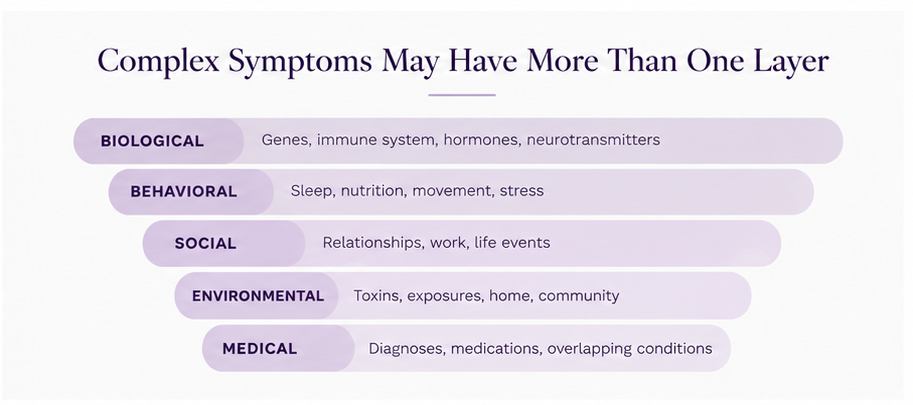
A whole-person perspective considers interconnected biological, behavioral, social, and environmental factors rather than viewing each organ system in isolation. The National Center for Complementary and Integrative Health (NCCIH) describes whole-person health in similar terms, while also noting that research on multicomponent whole-person interventions continues to develop.[3]
For one patient, sleep disruption, nutrition, medication effects, gastrointestinal symptoms, hormonal changes, environmental exposures, stress, or an established medical condition may interact. Addressing one important factor may improve part of the picture and make the next priority easier to see.
Why Experience and Clinical Judgment Matter
Franca Gardner, ANP-BC, DiHom, has more than 30 years of healthcare experience. With a complicated history, experience can help with pattern recognition: deciding which details deserve attention, which possibilities are less likely, what has already been adequately evaluated, and when conventional testing, referral, or another specialist is appropriate.
Experience is not a guarantee of a diagnosis or outcome. It is most valuable when paired with careful listening, evidence-informed reasoning, appropriate testing, and willingness to revise the working explanation when new information appears. AHRQ describes clinical reasoning as the process of applying medical knowledge to patient findings in context – and identifies it as a central part of diagnostic quality.[4]
Testing Should Answer a Question
When patients have been sick for years, it is understandable to want every possible test. More testing, however, is not automatically better. Tests are most useful when there is a reason for ordering them and a plan for interpreting the result.
AHRQ’s work on diagnostic stewardship highlights that poor test selection can create false positives, overdiagnosis, unnecessary treatment, and confusion, while under-testing can also contribute to missed diagnoses.[5] The practical question is: What are we trying to learn from this test, and how could the result change the next step?
That approach can be especially important in functional and integrative care, where patients may arrive with extensive prior laboratory work, supplement lists, specialist reports, imaging, and years of treatment history.
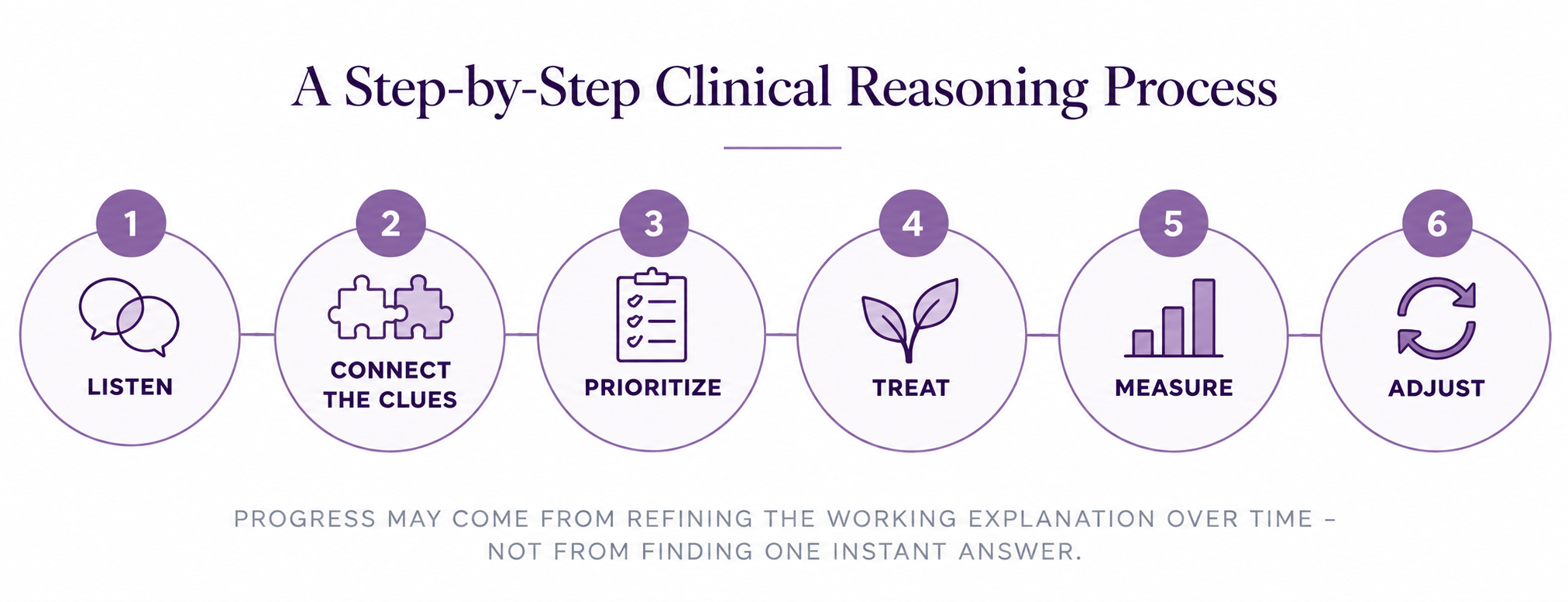
The Monarch Approach: Listen, Connect, Prioritize, Treat, Measure, and Adjust
The goal is not to force every symptom into one diagnosis or promise a quick fix. Monarch’s approach is to review the whole story, connect relevant clues, decide what deserves attention first, develop an individualized plan, and then evaluate what happens.
That process can be summarized as: Listen → Connect the Clues → Prioritize → Treat → Measure → Adjust.
The “measure and adjust” steps matter. Diagnosis and treatment can evolve over time. AHRQ describes diagnosis as a process that may extend across encounters, testing, referrals, follow-up, treatment, and outcomes rather than ending with a single office visit.[6] If an intervention does not produce the expected response, that information becomes another clue.
Why Progress May Take Time
Patients who have been unwell for several years are understandably eager to feel better. But an illness that developed or persisted over a long period may not be resolved in one appointment.
A first visit may identify immediate priorities rather than every answer. Some conditions require conventional evaluation or specialist care. Other contributors may become clearer only after an important issue is addressed and the response is observed.
A realistic goal is steady, thoughtful progress: understand what is known, identify what remains uncertain, address the most meaningful priorities, measure the response, and refine the plan. Integrative care should complement – not delay – appropriate conventional medical evaluation and treatment.[7]
Could This Approach Be Right for You?
A whole-person, step-by-step evaluation may be helpful when symptoms have persisted despite previous care, several body systems seem involved, your history has become difficult to summarize, or you feel that individual symptoms have been treated without someone reviewing the complete picture.
It may also be useful when you have accumulated years of records, testing, treatments, supplements, and specialist opinions and need help organizing what has already been learned.
Complex symptoms can also signal conditions that require prompt conventional or emergency medical care. New or severe chest pain, difficulty breathing, stroke-like symptoms, severe allergic reactions, major bleeding, sudden neurologic changes, or other urgent symptoms should not wait for an integrative evaluation.
A Practical Takeaway
When symptoms do not add up, the answer is not necessarily “more testing” or “one hidden root cause.” Often, the better starting point is a careful reconstruction of the story.
What happened first? What changed? Which findings are established? Which possibilities remain open? What has already been tried? What deserves attention now?
At Monarch Integrative Health, the goal is to bring those pieces together in a thoughtful, evidence-informed way and work through the problem step by step. For patients who have lived with unanswered questions for a long time, having the full story heard and organized can be an important beginning.
When Your Symptoms Don’t Add Up, You Deserve a Thoughtful Approach
If you’re navigating ongoing symptoms without clear answers, Monarch Integrative Health offers individualized care focused on understanding your complete health picture and identifying meaningful next steps.
References & Footnotes
[5] AHRQ. Diagnostic Stewardship as a Model To Improve the Quality and Safety of Diagnosis.

Franca Gardner
ANP-BC, DiHom