

Ozone therapy is an emerging and controversial complementary treatment. Laboratory research provides biologic reasons for continued study, but clinical evidence is inconsistent and generally low-certainty. Patients deserve a balanced discussion of what is known, what is not yet proven, and how safety and standard treatment options fit into the decision.
What Is Ozone Therapy?
Ozone (O₃) is a gas made of three oxygen atoms. It is highly reactive and is best known for its role in the upper atmosphere and as an air pollutant at ground level. Medical ozone therapy refers to a range of techniques in which a controlled oxygen–ozone mixture is used with therapeutic intent. Routes studied or promoted include topical application, injection into or around tissues, rectal insufflation, and procedures in which blood is removed, exposed to an oxygen–ozone mixture, and then returned to the patient.[1]
This is very different from simply “giving the body more oxygen.” Ozone is an oxidant. Researchers have proposed that carefully controlled exposure may trigger signaling responses involving oxidative stress, inflammation, and antioxidant defenses. A plausible mechanism, however, is not the same as proven clinical benefit.[1]
Why Has Ozone Therapy Attracted Interest?
Ozone has been investigated across a wide range of conditions because of its chemical reactivity and proposed effects on oxidative signaling. Research has explored dental applications, wound care, pain and musculoskeletal conditions, and several systemic illnesses. Some individual studies and reviews report improvements in selected outcomes, which helps explain continued clinical and research interest.
At the same time, the research is difficult to interpret. Treatment methods, concentrations, routes of administration, comparison groups, and patient populations vary substantially. Small studies and inconsistent safety reporting also make broad claims difficult to support.
What Does the Current Research Show?
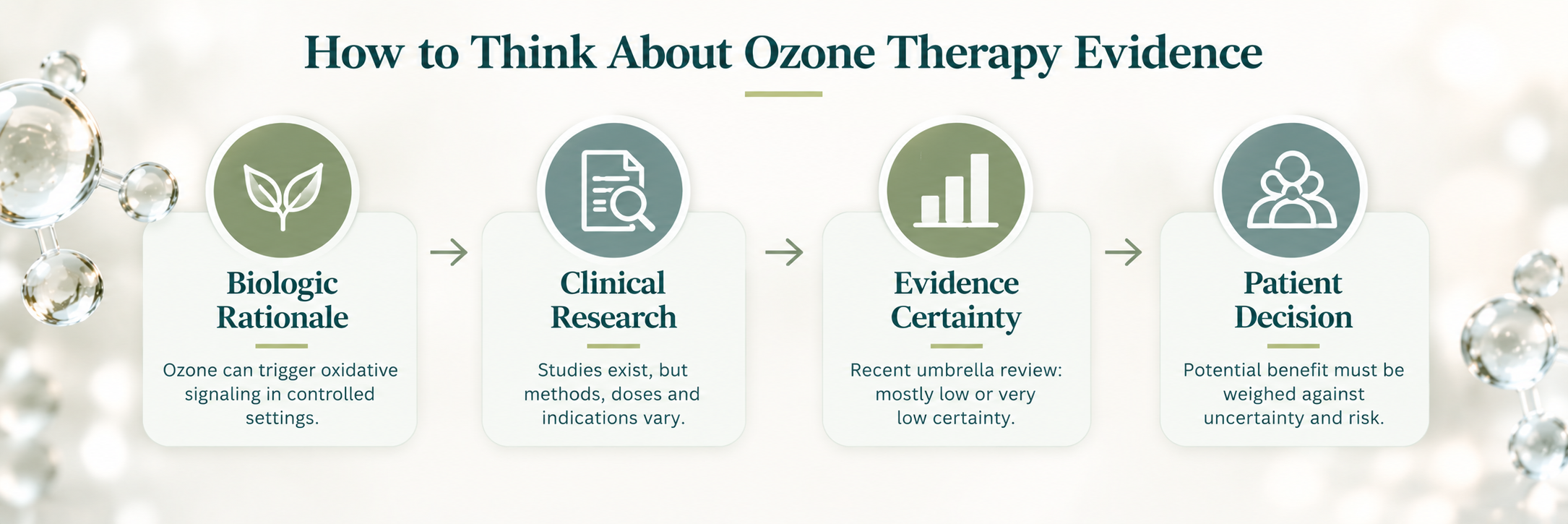
A 2026 umbrella review examined meta-analyses of randomized clinical trials of ozone therapy. It found evidence across only four indications that met its criteria: chronic periodontitis, COVID-19, diabetic foot ulcers, and impacted wisdom-tooth surgery. Results were mixed. Some selected outcomes showed possible benefit, while others did not show superiority over control treatment. Importantly, the certainty of evidence was rated low or very low across outcomes, and safety data were inconsistently reported.[1]
The authors concluded that current randomized-trial evidence is inconsistent and methodologically fragile and does not justify routine clinical use while better standardized trials are still needed.[1] That does not mean every proposed use has been disproven; it means the evidence is not strong enough to make sweeping claims about treating infections, “detoxifying” the body, regenerating tissue, or benefiting almost every disease.
How Does the FDA View Ozone for Medical Use?
U.S. regulation is an important part of an informed discussion. FDA device-labeling regulations restrict ozone emissions and do not permit ozone use for medical conditions when safety and effectiveness have not been established.[2] In July 2025, the FDA also issued a warning letter involving devices marketed for autohemotherapy/ozone-related uses, reinforcing that medical-treatment claims and devices are subject to federal requirements.[3]
For patients, the practical message is simple: ozone therapy should not be presented as an FDA-approved cure or broadly proven treatment for chronic disease. A clinic offering an adjunctive therapy should be transparent about the level of evidence and about how the proposed use fits with established care.
Is Ozone the Same as Breathing Oxygen?
No. Medical oxygen and ozone are not interchangeable. Ozone should not be inhaled as a therapy. Inhaled ozone can injure the respiratory tract, and much of the established human toxicology literature concerns its harmful effects on the lungs.[4]
Different ozone procedures also have different risk profiles. The route, concentration, equipment, sterility, anticoagulation when blood is handled, practitioner training, and the patient’s underlying medical conditions all matter. A general statement that ozone has an “unparalleled” safety record is not supported by the current evidence base.[1]
What Should Patients Ask Before Considering Ozone Therapy?
Before considering ozone therapy, ask what specific health problem is being targeted and what evidence supports that particular use. Ask whether established treatments have been considered, what route of ozone is proposed, what risks and alternatives exist, what training and protocols the practitioner uses, and how benefit will be measured.
This is especially important for people with complex chronic illness. When someone has been ill for months or years, it can be tempting to interpret one therapy as the missing answer. A better approach is to place any adjunctive therapy within the patient’s complete medical story.
Where Can a Functional & Integrative Approach Add Value?
A functional and integrative approach can be valuable because it asks a broader question than “Which therapy should we try?” It asks: What is driving the patient’s symptoms, what has already been evaluated, what treatments are essential, and what modifiable factors may support recovery?
At Monarch Integrative Health, that begins with understanding the whole patient—reviewing health history, medications and supplements, nutrition, sleep, gastrointestinal symptoms, activity tolerance, stress, environmental exposures, relevant laboratory findings, and previous responses to treatment. This broader perspective helps identify priorities and develop a coordinated care plan rather than focusing on any single intervention.
Within that framework, ozone therapy may be discussed as a potential adjunctive option for selected patients, but only with a clearly defined therapeutic goal, an honest discussion of the limited evidence and potential risks, and appropriate medical oversight. It is not presented as a cure-all or a substitute for established medical evaluation and treatment. Any consideration of its use should reflect the patient’s individual circumstances, safety concerns, and treatment goals, with ongoing reassessment of whether the intervention is providing measurable benefit.

The Bottom Line
Ozone therapy is an area of active interest, but the strength of clinical evidence has not caught up with many of the claims made about it. There are biologically plausible mechanisms and selected signals of benefit in the literature, but recent high-level evidence finds low or very low certainty and substantial variation among studies.[1]
For patients, that argues for neither hype nor automatic dismissal. It argues for informed decision-making. Emerging therapies should be discussed honestly, used only when appropriate, and never substituted for proven evaluation or treatment of serious medical conditions. The goal of integrative care is to combine curiosity with clinical judgment—and to keep the patient’s safety, goals, and whole health story at the center.
Wondering whether ozone therapy belongs in your treatment plan?
At Monarch Integrative Health, treatment decisions begin with understanding your complete health history, goals, previous care, and individual risk factors. If an adjunctive therapy is considered, it should have a clear purpose and be evaluated as part of the larger plan.
References & Footnotes
[3] U.S. Food and Drug Administration. Warning Letter: O3UV, LLC (CBER 25-668840). July 7, 2025.

Franca Gardner
ANP-BC, DiHom