
Homeopathy has been used for more than 200 years and remains part of complementary health care in many communities. It is also scientifically controversial: current high-quality evidence has not established homeopathy as an effective treatment for any specific health condition. Patients deserve both an accurate explanation of the tradition and a clear discussion of evidence and safety.
What Is Homeopathy?
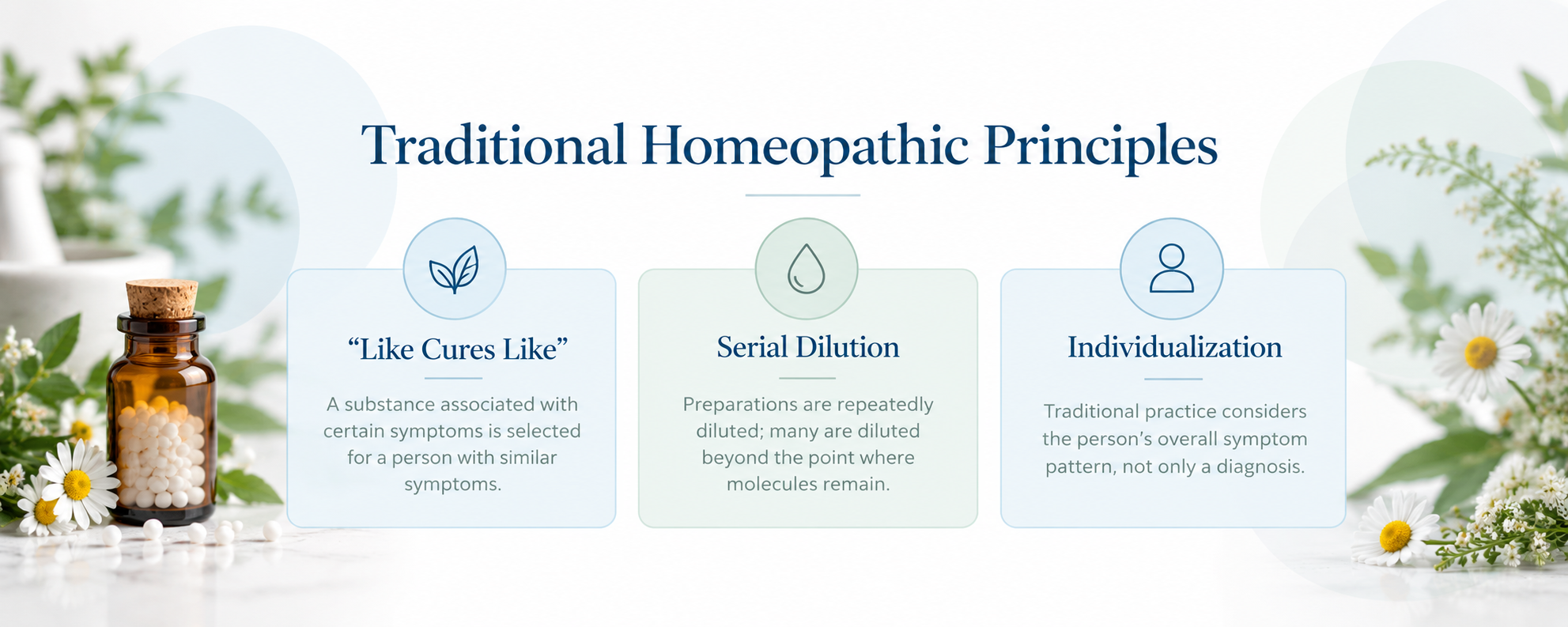
Homeopathy is a system of complementary medicine developed in Germany more than 200 years ago. Traditional homeopathy is based on two main ideas: “like cures like,” meaning a substance associated with symptoms in a healthy person is selected for someone experiencing a similar symptom pattern, and the “law of minimum dose,” in which preparations are serially diluted. Many homeopathic preparations are diluted so extensively that little or none of the original substance may remain.[1]
Homeopathic products may be made from plant, mineral, animal, chemical, or other source materials. Labels often identify ingredients by Latin or scientific names and list dilution levels such as 1X, 6X, or 30C.[2]
Why Is Homeopathy Considered Individualized?
Traditional homeopathic practice often places significant emphasis on the individual’s overall symptom pattern rather than selecting a remedy solely from the name of a diagnosis. A consultation may explore the timing and character of symptoms, factors that make them better or worse, sleep, appetite, stress, emotional state, and other aspects of the health history.
That detailed listening can be valuable in integrative care. However, the usefulness of a thorough history should be separated from claims about the effectiveness of a particular homeopathic remedy. A comprehensive interview can uncover important medical clues even when the treatment being considered has limited supporting evidence.
What Does Research Say About Effectiveness?
The National Center for Complementary and Integrative Health (NCCIH) states that there is little evidence supporting homeopathy as an effective treatment for any specific health condition.[1] This is an important update from some older discussions of homeopathy that cite individual positive trials or older meta-analyses without reflecting the totality and quality of the evidence.
Homeopathy therefore should not be described to patients as proven to stimulate the immune system, restore vitality, correct chronic disease, or reliably treat a particular diagnosis. People may report positive experiences, but an individual experience cannot establish that a highly diluted preparation caused the improvement.
Are Homeopathic Products FDA-Approved?
No. This is an important correction to a common misunderstanding. Homeopathic products are regulated as drugs under U.S. law, but no product labeled as homeopathic is FDA-approved. Products marketed in the United States have not undergone FDA review demonstrating safety and effectiveness for diagnosing, treating, curing, or preventing disease.[2][3]
FDA uses a risk-based enforcement approach, giving particular attention to products associated with safety concerns, serious-disease claims, vulnerable populations, non-oral or non-topical routes, and significant quality problems.[3]
Are Homeopathic Products Safe?
Many homeopathic products are extremely diluted, but “homeopathic” does not automatically mean risk-free. FDA and NCCIH note that some products have contained measurable amounts of active ingredients, and improperly manufactured products may have incorrect dilutions or contamination. Certain source materials can themselves be toxic, including belladonna, strychnine-containing nux vomica, mercury compounds, and lead compounds.[1][2]
The other major risk is indirect: relying on an unproven treatment can delay diagnosis or effective treatment of a serious illness. Patients should tell their healthcare professionals about all homeopathic products, supplements, herbs, and medications they use.
What About Homeopathic Vaccines or “Nosodes”?
Homeopathic products sometimes called “nosodes” or “homeopathic immunizations” should not be used as substitutes for recommended vaccination. NCCIH notes that there is no credible scientific evidence supporting homeopathic products as alternatives to conventional immunization.[1] This distinction is particularly important for children, older adults, pregnant patients, and people whose medical conditions place them at greater risk from infection.
Where Can Homeopathy Fit Within an Integrative Practice?
At Monarch, homeopathy may be considered as a complementary option for patients who are interested in it, but it is not presented as a replacement for appropriate medical evaluation or established treatment. Franca’s homeopathic training also emphasizes detailed history-taking and individualized assessment—skills that complement Monarch’s broader whole-person approach to complex health concerns.
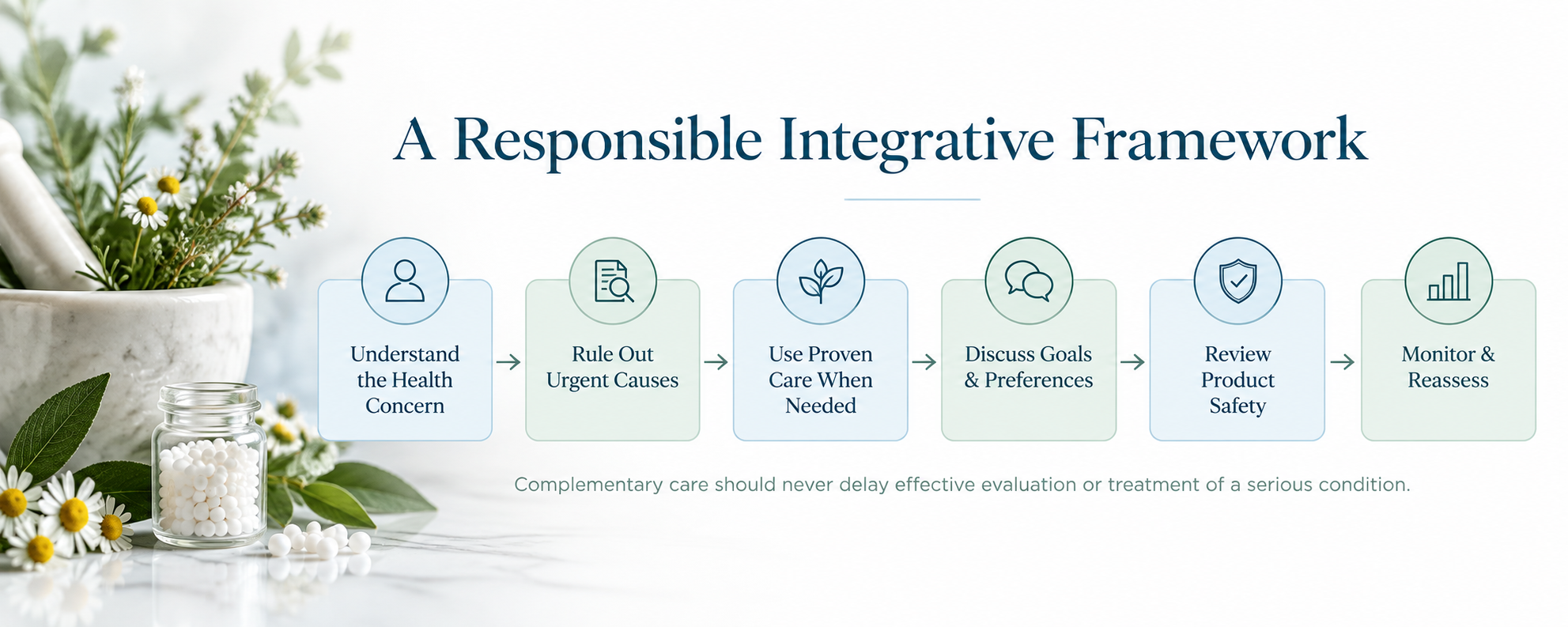
Integrative care can respect a patient’s preferences while still being clear about evidence. If a patient is interested in homeopathy, the first responsibility is to understand the health concern and determine whether symptoms require conventional diagnostic testing, urgent evaluation, or an established treatment.
For non-urgent concerns, a clinician can discuss what the patient hopes to accomplish, review medications and supplements, identify potential product-safety concerns, and decide whether a complementary approach is reasonable without displacing effective care. This is especially important in complex chronic illness, where symptoms can have multiple contributors and patients may already be using many therapies.
The Monarch Integrative Health Approach
At Monarch Integrative Health, the larger goal is not to force every patient into one treatment philosophy. It is to understand the whole health story. A detailed history can help connect symptoms, prior diagnoses, medications and supplements, nutrition, sleep, stress, environmental exposures, gastrointestinal concerns, and other factors that may be influencing health.
When complementary approaches are considered, they should be placed within that larger picture. The questions remain practical: What problem are we trying to solve? What has been ruled out? What evidence supports the available options? Is the approach safe for this patient? What other treatments should continue? And how will we know whether the plan is helping?
A Practical Takeaway
Homeopathy has a long history and a highly individualized philosophy, but longevity and popularity are not the same as scientific proof. Current evidence has not established homeopathy as an effective treatment for specific health conditions, and homeopathic products sold in the United States are not FDA-approved.[1][2]
Patients interested in homeopathy do not need to choose between curiosity and good medical judgment. A responsible integrative approach can acknowledge patient preferences, avoid exaggerated claims, protect against unsafe products or delayed treatment, and keep evidence-based evaluation and the patient’s overall health at the center of care.
References & Footnotes

Franca Gardner
ANP-BC, DiHom