

Complex symptoms rarely follow a textbook. When several body systems are involved – or symptoms continue despite previous care – experience can help a clinician know what to prioritize, what to question, when testing may help, when to adjust, and when another specialist may be needed.
If you’ve been dealing with symptoms that don’t seem to fit neatly into one diagnosis, read When Symptoms Don’t Add Up to learn how a step-by-step approach can help connect the clues.
Why Experience Becomes More Important in Complex Care
For a straightforward problem, the path from symptom to diagnosis to treatment may be relatively direct. Complex chronic illness can be different. Symptoms may involve several body systems, change over time, overlap with other conditions, or respond only partly to previous treatment. The challenge is often not finding one more protocol. It is understanding the whole history, recognizing patterns, deciding what deserves attention first, and adapting as new information appears.
AHRQ describes diagnosis as beginning with an appropriate patient history and examination and then depending on clinical reasoning to make sense of findings in context.[1] That context matters. A laboratory result, symptom, medication, exposure, or prior treatment response can mean something different when viewed as part of a larger health story.
What Does Clinical Experience Actually Add?
Experience is more than the number of years someone has practiced. In complex care, its value is in how knowledge is applied. Repeated exposure to real clinical situations can strengthen pattern recognition and help a provider distinguish a potentially important clue from background noise.
It can also improve prioritization. When a patient arrives with years of records, multiple diagnoses, long supplement lists, specialist opinions, and dozens of symptoms, trying to address everything at once can create more confusion. Thoughtful care asks: What appears most important now? What is already established? What remains uncertain? What needs conventional evaluation? What can safely wait?
Experience is not a guarantee of the right answer. It is most useful when combined with careful listening, evidence-informed reasoning, appropriate testing, communication, and a willingness to reconsider the plan.
Five Ways Experience Can Strengthen Care
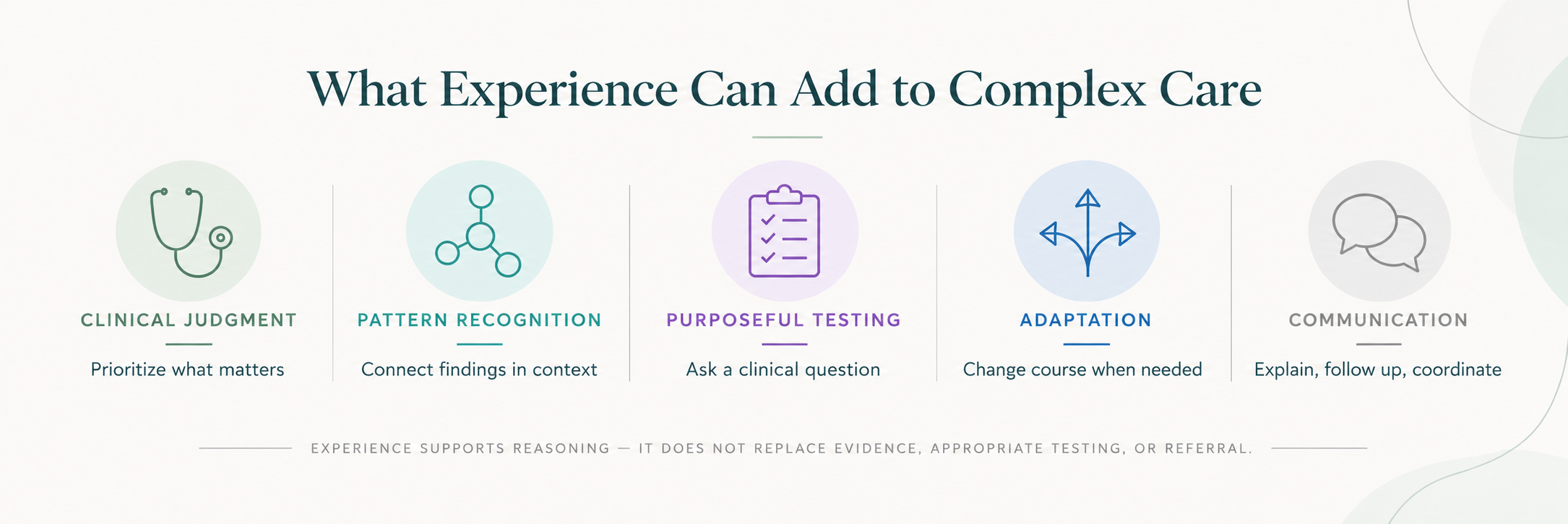
Clinical judgment helps determine what deserves attention first. Pattern recognition can reveal relationships among symptoms, timing, medications, lifestyle, exposures, and previous treatment response. Purposeful testing helps avoid collecting data without a clear clinical question. Adaptability matters because patients do not always respond as expected. Communication and follow-up make it possible to explain the plan, measure progress, and coordinate care when another clinician or specialist is needed.
These ideas also fit a whole-person framework. NCCIH describes whole-person health as considering interconnected biological, behavioral, social, and environmental factors rather than treating body systems as completely separate.[2] Integrative health similarly emphasizes coordinated care that can bring conventional and complementary approaches together for the whole person.[3]
What Thoughtful Care Should Avoid
A useful way to evaluate experience is not to criticize less-experienced providers, but to ask what good care should look like.
Too much at once can make it difficult to know what is helping, what is causing side effects, and what the patient can realistically sustain. Treating a laboratory result instead of the person can miss the importance of symptoms, history, medications, examination findings, and other clinical information. Skipping foundations such as sleep, nutrition, movement, hydration, and stress can leave important contributors unaddressed.
Testing without a clear question can also create problems. AHRQ’s diagnostic-stewardship framework emphasizes ordering the right test for the right patient at the right time to obtain information needed for clinical care.[4] More testing is not automatically better. Finally, failing to reassess can turn persistence into repetition. If progress is not occurring as expected, the working explanation and plan deserve another look.
A Good Plan Should Be Understandable
Patients should understand what their provider is investigating, why a test or treatment is being considered, what improvement would look like, and when the plan will be reassessed. That does not mean every uncertainty can be eliminated. It means the reasoning should be explainable.
For complex illness, the first visit may identify priorities rather than produce a final answer. Some findings may require conventional testing or specialist referral. Others may be addressed step by step. The response to treatment can itself provide useful information and may change what deserves attention next.
The Monarch Approach
At Monarch Integrative Health, Franca Gardner, ANP-BC, DiHom, brings more than 30 years of healthcare experience to helping patients navigate complex chronic illness through thoughtful evaluation, clinical judgment, and individualized care.
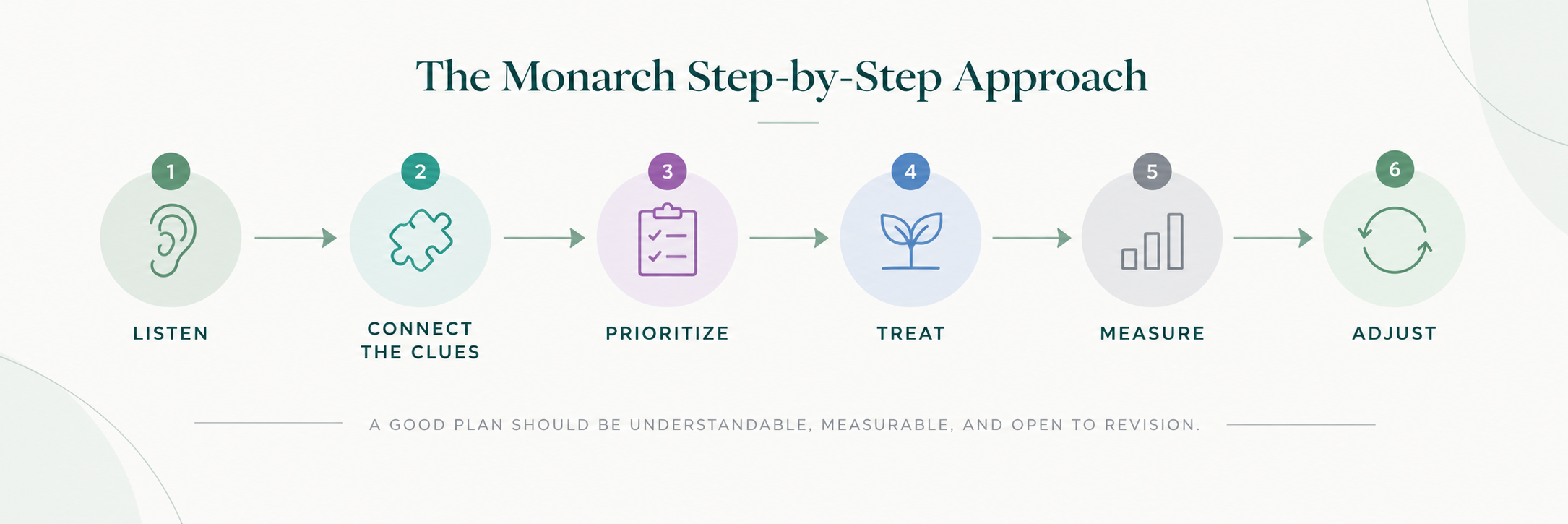
The process can be summarized as: Listen → Connect the Clues → Prioritize → Treat → Measure → Adjust.
That sequence is intentionally simple. Listen carefully to the complete history. Connect symptoms and findings that may be related. Prioritize rather than trying to change everything at once. Treat based on the working clinical picture. Measure whether the patient is actually improving. Then adjust when the response, new information, or changing circumstances suggest a different direction.
This is where experience can be especially valuable: not simply knowing more possibilities, but knowing how, when, and why to apply that knowledge.
Questions You Can Ask Any Provider
Patients can learn a great deal by asking a few direct questions: How much experience do you have with patients whose symptoms are similar to mine? How will you decide what to address first? What is the purpose of each test, supplement, medication, or therapy you recommend? How will we measure whether the plan is working? What happens if I am not improving as expected? When would you refer me to another clinician or specialist?
The answers should help you understand both the provider’s experience and their process. Good care does not require a promise of certainty. It should demonstrate thoughtful reasoning, appropriate boundaries, and a plan for follow-up.
A Practical Takeaway
When health is complex, experience matters because care involves more than identifying possible diagnoses. It requires judgment about what information matters, what should happen next, what can be simplified, and when the plan needs to change.
For patients who have already seen multiple providers, the goal should not be another overwhelming protocol. A more useful goal is a clear, individualized process that considers the whole person, uses testing purposefully, coordinates appropriate conventional and integrative care, and reassesses progress over time.
It is not just what a provider knows. In complex care, it is also how, when, and why that knowledge is applied.
References & Footnotes
[3] NCCIH. Complementary, Alternative, or Integrative Health: What’s In a Name?
[4] AHRQ. Diagnostic Stewardship as a Model To Improve the Quality and Safety of Diagnosis.

Franca Gardner
ANP-BC, DiHom